The Four Layers, Part 1: What Recorded Measurements Really Record
In my first article in this series, I proposed four layers of the scientific record that AI models in biology learn from: recorded measurements, systematic datasets, processed results, and interpretations. Over the next few articles, I'll take each layer in turn.
Why I propose this layer
Recorded measurements are the foundation of every other layer. A screen, an IC50, or a claim about a mechanism all start from something an instrument recorded. I separate this layer because it is where people most often stop asking questions. A measurement feels objective: an instrument recorded a signal, and no one has interpreted it yet.
My bench years taught me to keep asking.
What the layer is
This layer holds what an instrument captured: a plate-reader signal, a microscope image, a stained tissue section, a band on a western blot, sequencing reads, a mass spectrum. It is the closest the record gets to the experiment itself.
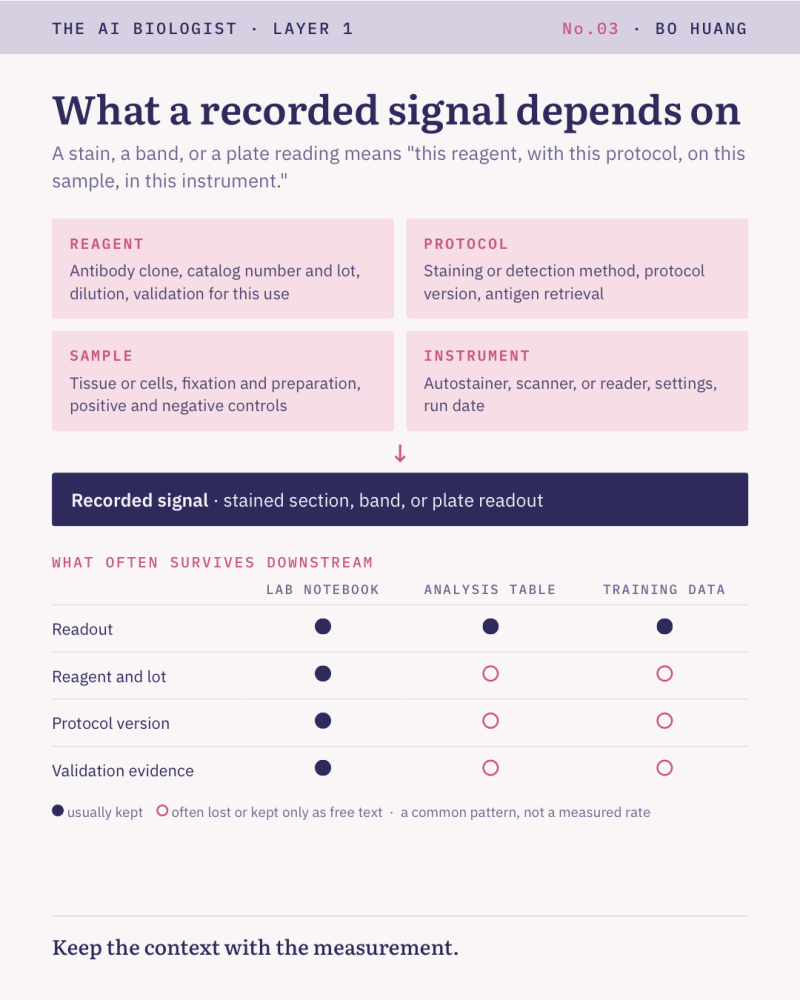
But a recorded signal always means more than "this is the biology." It means this reagent, used with this protocol, on this sample, in this instrument, produced this readout. Change any part and the meaning can change.
A real example: one tumor, four PD-L1 tests
PD-L1 is a protein on tumor and immune cells, and its level helps decide which lung cancer patients receive immunotherapy. Each of these drugs was developed together with its own staining test (an assay), so several PD-L1 assays reached the clinic. Each one has its own antibody, protocol, staining machine, and scoring rules.
The Blueprint project, a collaboration among drug and diagnostics companies, pathologists, and professional societies, stained the same 39 lung tumors with four of these assays (22C3, 28-8, SP142, and SP263).
- Tumor cells: three assays stained similar percentages of tumor cells. The fourth, SP142, consistently stained fewer.
- Immune cells: staining varied even more across the assays.
- Patients: for 14 of 38 tumors (37%), PD-L1 status would have changed depending on which assay and cutoff were used.
A second phase used 81 routine clinical samples and an international panel of pathologists, and added a fifth assay. It confirmed the pattern: 22C3, 28-8, and SP263 gave very similar results, SP142 was less sensitive, and the new assay, 73-10, was more sensitive. Pathologists agreed closely when scoring tumor cells but barely agreed on immune cells.
Same tumors, same protein, different numbers. No one made an error; each assay worked as designed. The lesson is that a recorded signal is only as meaningful as the record of how it was produced. A score of "50% of tumor cells PD-L1 positive," the cutoff for one first-line immunotherapy option in lung cancer, means little without knowing which assay produced it, which cells were scored, and who scored them.
I've seen this in my own field. For years, studies disagreed about where estrogen receptor β (ERβ) is found, including in breast tumors. In 2017, a team tested 13 ERβ antibodies, including the one we used in my lab, and found that only one was specific in their tissue-staining tests. Part of a long scientific debate may have been about the antibodies, not the biology. That finding changed how I read every staining result, including my own.
Research antibodies are not reviewed by regulators the way clinical tests are, and they show the same problem at a larger scale. In 2023, the YCharOS initiative tested 614 commercial antibodies against 65 human proteins. Each antibody was compared in normal cells and in cells where the target gene had been removed (knocked out). More than half failed in at least one application. Of 2,010 publications that had used 180 of the tested antibodies for western blots, about 31% had used an antibody that failed the team's western blot test. Many manufacturers then updated or withdrew products. The problem can be fixed once it is measured.
What it means
For scientists: the reagent and protocol are part of the result. Record the antibody clone, catalog number, lot, dilution, and validation evidence as carefully as the readout itself, and check them when you rely on someone else's data.
For AI teams and models: a model trained on these signals, or on datasets built from them, cannot know which antibody produced each data point unless that information is stored with the data. When the same reagent is used across many studies, its problems repeat across the training set instead of averaging out.
For companies building AI in life sciences: the quality of the first layer sets limits for every model built on top of it. Capturing measurement context at the source is cheaper than discovering a reagent problem after a model has been trained.
Three questions to ask
- What produced this signal, and was it validated for this use? Validated for western blot is not the same as validated for tissue staining.
- Are the reagent and protocol details recorded in a form I can query? If they exist only in a methods section, they are usually lost when the data moves into datasets and models.
- Do independent methods agree? A result confirmed with a different antibody, a knockout control, or a different technique is stronger evidence than one signal repeated many times.
How a data platform helps
At Databricks, I work with biotech and pharmaceutical teams on their data and AI platforms. A pattern I see often: the details that determine what a measurement means are the first to get lost as results move from the lab notebook into datasets and analysis tables. The readout survives; the reagent and protocol details often don't, or they survive only as free text.
Here is how a platform can keep them, following the three questions above:
- Keep raw files with their context. Unity Catalog volumes store raw instrument files, such as images, plate-reader exports, and sequencing files, under the same access controls as tables. A metadata table beside them can record the reagent, lot, protocol version, and instrument for each run.
- Trace where they were used. Unity Catalog data lineage shows which downstream tables and models used a given file or table, so if a reagent is later found to be unreliable, you can find every result that used it and remove those results before they become training data.
- Use shared identifiers. Recording Research Resource Identifiers (RRIDs) for antibodies makes the same reagent recognizable across studies and data sources.
In an assay-data platform I built recently, results came from several lab systems, including an electronic lab notebook where formulation details were recorded. The core of the design was a data model that keeps each result tied to its sample, lot, protocol, and units, so a scientist never sees the number on its own.
I work at Databricks, so these are the tools I know best; other platforms offer similar capabilities. This section reflects my own experience, not an official Databricks statement.
Which reagent or assay in your field would you least want an AI model to trust without checking?
Views are my own and do not represent my employer.
Sources
- Hirsch FR, et al. PD-L1 immunohistochemistry assays for lung cancer: results from Phase 1 of the Blueprint PD-L1 IHC Assay Comparison Project. Journal of Thoracic Oncology 12, 208–222 (2017). https://doi.org/10.1016/j.jtho.2016.11.2228
- Tsao MS, et al. PD-L1 immunohistochemistry comparability study in real-life clinical samples: results of Blueprint Phase 2 Project. Journal of Thoracic Oncology 13, 1302–1311 (2018). https://doi.org/10.1016/j.jtho.2018.05.013
- Andersson S, et al. Insufficient antibody validation challenges oestrogen receptor beta research. Nature Communications 8, 15840 (2017). https://doi.org/10.1038/ncomms15840
- Ayoubi R, et al. Scaling of an antibody validation procedure enables quantification of antibody performance in major research applications. eLife 12, RP91645 (2023). https://doi.org/10.7554/eLife.91645
- Research Resource Identifiers: https://www.rrids.org/