What Is AI Really Learning About Biology?
A bench scientist who now works in AI looks past the headlines at four layers of scientific evidence.
AI companies are moving deeper into the work of science. On November 11, 2026, Google DeepMind announced AlphaGenome 2, drawing on more than 100 million cell profiles. On October 27, Anthropic disclosed its acquisition of Mithril Medicine alongside early drug-development work with biotech and pharma teams. And on October 20, OpenAI announced it had acquired Orchestra Bio, a platform for coordinating biopharma development work.
A model release, experimental research, and acquisitions tell us different things. Together, they show a growing effort to connect AI with scientific data, experiments, and the work of developing medicines.
With all these AI-for-Science headlines, a former lab colleague recently contacted me. Their questions, paraphrased, were: You work in data and AI now. Can these models replace scientists? How can we trust the models—and the data they generate?
I spent more than 10 years at the bench before moving into data and AI. Today, at Databricks, I work with teams across biotech and pharmaceutical organizations to put data and AI into practical use.
A data and AI platform helps connect models with an organization’s data and make them accessible to researchers through tools they can use in their work. That is an important part of what I do. But making a model accessible and knowing when to trust its output are separate challenges.
Both sides of my experience bring me back to the same question: what did the model actually have to work with?
Was it learning a relationship between a sequence and an experimental readout? Searching a database for an overlooked pattern? Or assembling a hypothesis from published papers?
Those are different scientific tasks. Understanding the evidence behind them helps us judge what an achievement means.
Four layers of the scientific record
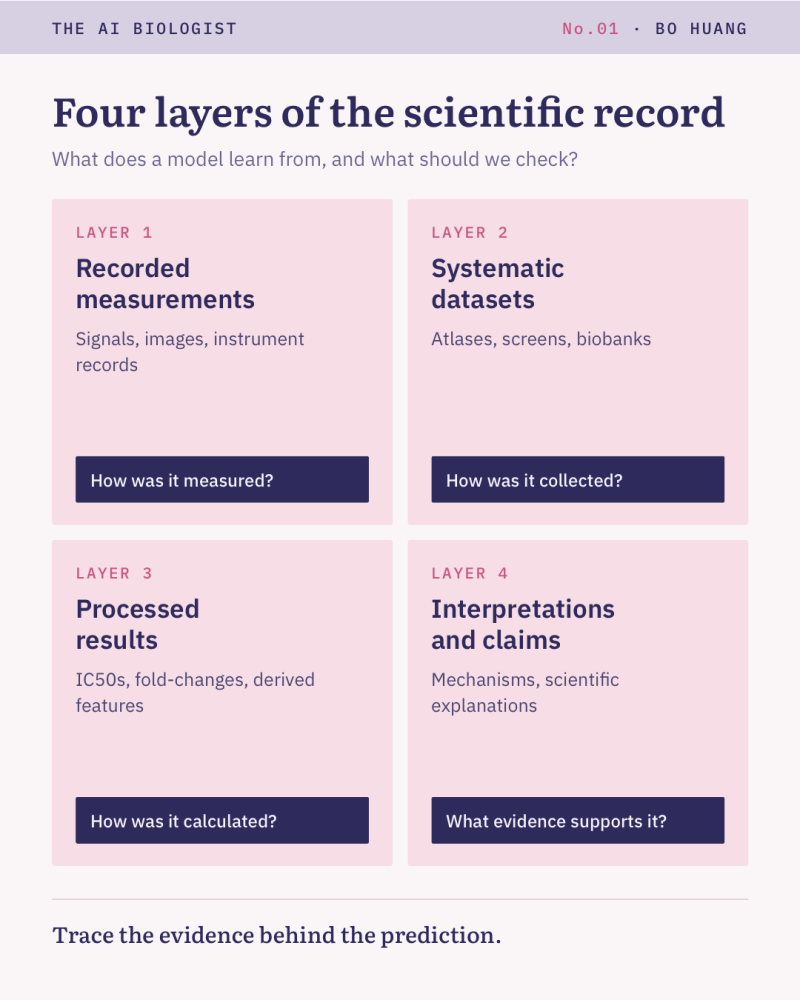
I find it useful to separate the record into four layers: recorded measurements, systematic datasets, processed results, and interpretations. Each layer needs different questions: how was the evidence produced, and what does it support?
Here is a simple example: a lab tests a compound on cultured cells and measures a signal associated with cell viability.
Layer 1 — Recorded measurements
The instrument records a signal for each well. The file, controls, calibration, and sample identifiers let another researcher inspect what was recorded. The signal still needs context: it is a readout from an assay, not a full picture of everything happening inside the cells.
Layer 2 — Standardized, systematic datasets
Now consider a coordinated screen across many cell lines, using documented protocols, controls, and quality checks. Atlases, screens, and biobanks organize observations so they can be compared and reused. These collections contain measurements, processed outputs, and metadata. Their value depends on how consistently these pieces were collected and described.
Layer 3 — Processed results
The lab normalizes the signals, fits a dose-response curve, and reports an IC50. That number depends on the assay conditions, the fitting method, and the quality-control decisions. To reuse it, we need to know how it was calculated and what biological question the assay can answer.
Layer 4 — Interpretation and scientific claims
The researchers propose that the compound affects a disease-relevant pathway. That conclusion may be based on several experiments, including controls that help rule out other explanations. To assess it, we examine how well the evidence supports the proposed mechanism and whether independent work reaches the same conclusion.
Reading the new announcements through the evidence
DeepMind’s AlphaGenome 2 brings together bulk and single-cell data to predict molecular properties in particular tissues and cell states. It connects systematic datasets with processed experimental readouts such as gene expression and chromatin accessibility. A predicted molecular effect still needs further evidence before it becomes a claim about disease. DeepMind states that the model has not been validated or approved for clinical or diagnostic purposes.
Anthropic’s October update describes experimental drug-development work as well as its acquisition of Mithril Medicine. Here, the important evidence includes the assay results supporting the proposed candidates and the limits of those experiments. The reported work is early and mostly preclinical. Promising lab or animal results are not evidence of benefit in patients.
OpenAI’s Orchestra Bio acquisition concerns another part of the scientific process: coordinating studies, dependencies, and decisions across drug development. It shows investment in connecting AI with how biopharma work is done. The acquisition itself does not show a new biological finding, and it does not show that a model's predictions are reliable.
For all three, I would separate what the model was trained on, what information it used during a task, and what evidence was used to check the result. A release announcement or acquisition does not show the full history of the training data. Scientific claims need to be traced to the measurements, analyses, and experiments that support them.
Why the evidence trail matters
Biologists have been dealing with these distinctions for a long time. In 2012, Begley and Ellis reported that scientists at Amgen could confirm findings from 6 of 53 selected landmark preclinical cancer studies. That finding describes one set of studies and replication attempts. It is not a percentage we can apply to all of biology.
For AI, it raises a practical question: if a model reproduces a published claim accurately, has it reproduced reliable evidence—or a claim that needs further testing?
Large datasets do not answer that question by themselves. Imagine a bathroom scale that consistently reads two kilos too heavy. Weighing yourself many times makes the average more precise, but it is still two kilos too heavy. Shared reagent problems, sampling biases, and selective reporting can also repeat across many records in the same way.
A useful evidence trail lets us inspect those possibilities. We can check instrument controls, dataset coverage, analysis choices, or the experiments supporting a mechanism, depending on the claim being made.
What I would ask before using a prediction
Three questions help me connect the model back to the science:
- What evidence supports this particular output? Training data, a retrieved paper, a tool calculation, and a new experiment play different roles.
- Can I trace the relevant measurement and analysis? I want to understand the samples, conditions, processing, and limits that matter for my use.
- What independent check would justify acting on it? A literature summary needs source verification. A computed result needs reproducible inputs and code. A biological prediction needs an appropriate experimental test.
These questions also apply to AI-generated data. A simulation or synthetic dataset can be useful for a specific purpose, but it should always be clearly labeled, so no one mistakes it for measurements from a real experiment.
How a data platform helps trace the evidence
At Databricks, I help biotech and pharmaceutical teams build this kind of evidence trail into their data and AI platforms:
- Keep the record together. Unity Catalog governs raw instrument files (in volumes), datasets, and processed results under one set of permissions.
- Trace a result to its sources. Data lineage connects a table or prediction back to the files and tables it came from.
- Record what produced a prediction. MLflow records which model version, data, and settings produced a result, and MLflow evaluation checks whether an AI assistant's answers are supported by its sources.
I work at Databricks, so these are the tools I know best; other platforms offer similar capabilities. This section reflects my own experience, not an official Databricks statement.
A starting point for The AI Biologist
My answer to my former colleague starts with the task: what can the system do, which evidence supports that capability, and how will we check its output in our own work?
That is what I want to explore in this series, drawing on my experience at the bench and in data and AI. This article introduces one idea from my book in progress, The AI Biologist. The book goes further into how to assess and apply these tools in research.
When you use AI for research, how far back can you trace its answer to the evidence? I would welcome examples from academic labs and industry.
Views are my own and do not represent my employer.
Sources
The company announcements below describe model capabilities, research progress, or acquisitions. Read their scientific claims together with the published methods and data, and with later independent reviews.
- Google DeepMind. AlphaGenome 2: Deciphering how cells read DNA to better understand disease (November 11, 2026).
- Anthropic. Early progress on accelerating drug development with Claude (October 27, 2026; includes disclosure of the Mithril Medicine acquisition).
- OpenAI. OpenAI acquires Orchestra Bio (October 20, 2026).
- Begley CG, Ellis LM. Raise standards for preclinical cancer research. Nature 483, 531–533 (2012). https://doi.org/10.1038/483531a