What to Hand to AI in Your Research, and What to Keep
Where AI helps scientists today, what to keep for yourself, and how to start using it well.
My last article looked at AI from the data side: what models learn from biology, and which layers of the scientific record support their predictions. This one looks from the scientist's side: which parts of your research you can hand to AI today, and which you should keep. The two go together. Knowing what a model learned from tells you how far to trust it. Knowing what it does well tells you where to use it.
That article began with a question from a former lab colleague: can AI replace scientists? I didn't answer it directly then. Here is my answer now.
AI isn't good or bad for science on its own. It's a set of tools, and the results depend on how we use them: which tasks we hand over, which data the tools work with, and how we check what they produce. Used well, AI gives researchers back time for the parts of science that need them most. Used carelessly, it produces confident answers that nobody has checked.
Roles will change. Some tasks that took a scientist hours now take minutes. But the questions worth asking, the experiments worth running, and the decisions about what the evidence supports still belong to the people doing the science.
Then and now
When I worked at the bench, much of my time went into the work around the experiments rather than the experiments themselves.
A project usually started in PubMed. I searched a few keywords at a time, downloaded the PDFs, printed them, and compared results across groups by hand, copying the key numbers into a spreadsheet. I designed experiments and did the calculations in that same spreadsheet, or in whatever bioinformatics tool I could run myself. For anything bigger, I waited until a bioinformatician had time. After the experiments came the analysis and the figures, then the paper: reading the newest literature again, comparing my results with everyone else's, and spending hours reformatting text and checking references to fit each journal's rules. Every grant application repeated the cycle, with its own forms to fill in by hand.
The search step was the hardest part to do at a larger scale. To find a druggable target or pathway protein behind a cancer phenotype, I could only try one combination of keywords at a time. My collaborations with pharmaceutical companies on target validation and ligand screening had the same problem. Every candidate we chose to test cost weeks at the bench, so choosing well mattered, but the evidence for choosing was scattered across hundreds of papers. Today an AI assistant can run many of those searches in parallel and bring the candidates and the evidence for each into one place. The bench test still decides, but we reach it with better candidates.
It wasn't only me. In a 2018 survey of about 12,000 US researchers with federal funding, investigators reported spending 44% of their research time on administrative work. Australian researchers spent an estimated 34 working days on each grant proposal, and reformatting one manuscript for a journal took a median of 14 hours. Industry has its own version of the problem. When Bayer tried to confirm published target data in its own labs, the published data fully matched its own findings in only 20–25% of projects, and a company's own results are often spread across systems that are hard to search together.
Today, at Databricks, I work with biotech and pharmaceutical teams on their data and AI platforms. One change stands out: research teams can now set up AI assistants that work with their own documents and experimental data. A scientist can ask a question in plain language and get an answer drawn from the organization's own records, with the sources shown.
The technology matters, but so does the setup: which data the assistant can see, who can access it, and how answers can be checked. I describe how I set this up with teams near the end of this article.
Where AI helps scientists today
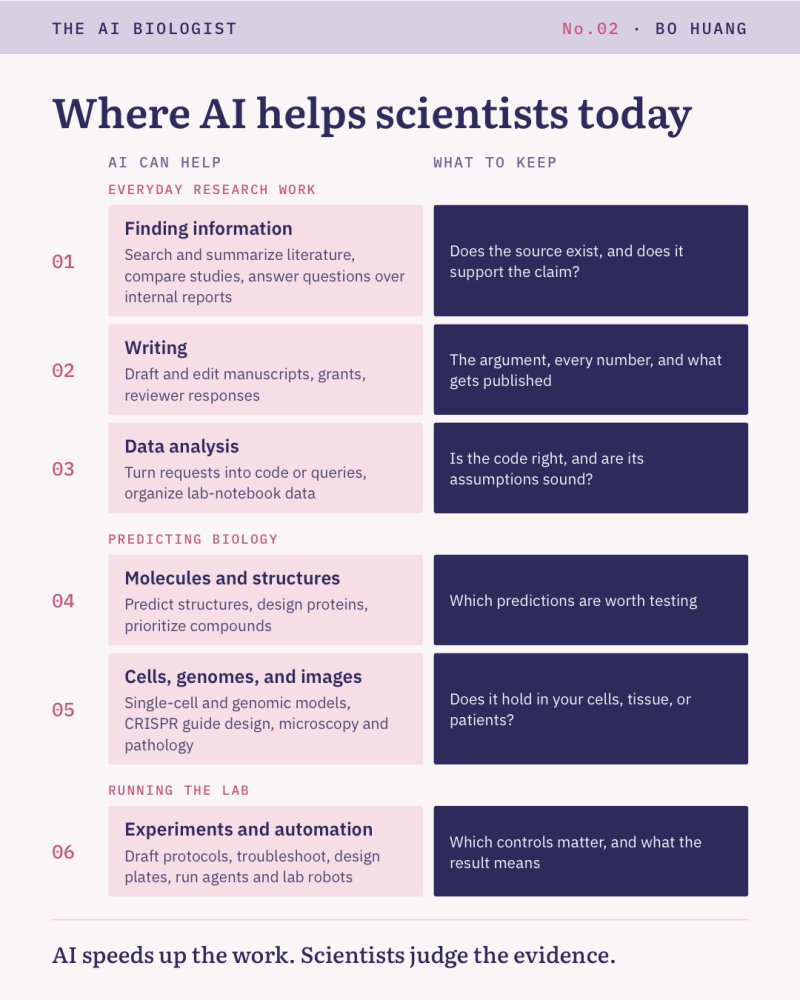
Here is a simple map in three groups: the everyday work every scientist does, the models that predict biology, and the lab where predictions get tested. Later articles in this series go deeper into several of them.
EVERYDAY RESEARCH WORK
1. Finding and reading information
AI assistants can search the literature, summarize papers, compare findings across studies, and answer questions over internal reports and protocols.
What to keep: confirming that a cited source exists and actually supports the claim.
2. Writing and communication
AI can help draft and edit manuscripts, grant sections, reviewer responses, figure legends, and plain-language summaries.
What to keep: the scientific argument, every number, and responsibility for what is published. Check your journal's policy on disclosing AI use.
3. Data analysis and lab records
AI can turn a plain-language request into analysis code or a database query, explain unfamiliar methods, help debug pipelines, and organize data from lab notebooks. For bioinformaticians, it speeds up routine scripting. For wet-lab scientists, it makes it easier to analyze their own data.
What to keep: reading the code, checking its assumptions, and testing it on a case where you know the answer.
PREDICTING BIOLOGY
4. Molecules and structures
Specialized models predict protein structures, propose new protein designs, and help prioritize compounds for drug discovery.
What to keep: treating each prediction as a hypothesis, and choosing which ones are worth testing.
5. Cells, genomes, and images
Foundation models trained on single-cell and genomic data suggest cell states and gene functions, estimate the effects of genetic variants, and help design CRISPR guides. Image models segment cells, read microscopy at scale, and analyze pathology slides.
What to keep: checking that a result holds in your cell type, your tissue, or your patients, not only in the data the model was trained on.
RUNNING THE LAB
6. Experiments and automation
AI can help draft protocols, troubleshoot failed experiments, and design plate layouts. AI agents and lab robots are starting to run parts of experiments with less hands-on work.
What to keep: deciding which controls matter, and what the result actually means.
Different starting points
Wet-lab scientists: start with the work around your experiments, such as literature searches, protocol drafts, and first-pass data analysis. These save the most time with the lowest risk.
Bioinformaticians: use AI to speed up routine coding and documentation, and spend the time saved on study design and validation.
Academic labs: general-purpose AI assistants are a practical starting point. Follow your institution's rules on data, especially for unpublished or patient data.
Industry teams: the bigger opportunity is connecting AI to your organization's own governed data, so answers come from your experiments rather than only from the public literature.
Four habits for using AI well
- Start with one repetitive task. Pick something you do every week and test whether AI makes it faster without making it worse.
- Give it your context. Results improve when the assistant works with your data, your documents, and a clear description of your goal.
- Check against something you know. Before trusting an answer on a new question, test the tool on one where you already know the answer.
- Protect your data. Don't paste confidential, unpublished, or patient data into tools your organization hasn't approved.
How I set this up with research teams
At Databricks, my work with biotech and pharmaceutical teams often starts with the same goal: let scientists use AI on their own data without losing track of where answers come from or who can see what. Here is how the map above looks in a platform setup:
- Finding information: assistants that search literature and internal documents, built on Databricks AI Search, can return the passages behind each answer so scientists can check them.
- Data analysis: Genie Agents let researchers ask plain-language questions of governed tables and documents, and Genie Code helps write and debug analysis code in notebooks.
- Molecular prediction and other specialized models: Model Serving runs models next to the organization's data, so predictions can be compared directly with internal results.
- Checking quality: MLflow evaluation and tracing record what an assistant did and score whether its answers are supported by its sources.
- Protecting data: Unity Catalog controls which data each user and each assistant can access, and keeps an audit trail.
I work at Databricks, so these are the tools I know best; other platforms offer similar capabilities. This section reflects my own experience, not an official Databricks statement.
Back to my colleague's question
Will AI replace scientists? I don't think that is the most useful question. A better one is: which parts of the work can AI do reliably, and how quickly can scientists learn to use it well? The researchers who learn that will have more time for the work only they can do.
That connects to my last article: as AI takes on more of the work, it matters even more that we can trace its answers back to the evidence.
Next comes the four-part series many of you asked for, one article for each layer of the scientific record, starting with recorded measurements. After that, I'll go deeper into areas on this map, starting with molecules and structures.
Where has AI saved you the most time in your research so far, and where has it let you down? I'd like to hear from wet-lab scientists, bioinformaticians, and research teams in both academia and industry.
Views are my own and do not represent my employer.